27 Sentence and government theory
THIS BOOK IS A WORK IN PROGRESS. IT IS INCOMPLETE AND MAY HAVE TYPOGRAPHICAL AND OTHER ERRORS. IT IS NOT YET READY TO BE STUDIED FROM.
27.1 Introduction
In this chapter, we will study the Arabic grammatical model for constructing sentences. We will first define some linguistic terms.
27.1.1 Truth-evaluability
Statements are classified into two types:
- a truth-evaluable statement
- a non-truth-evaluable statement
A truth-evaluable statement is one that can be judged to be true or false. In other words it is falsifiable. For example, if we have a statement:
- زَيْدٌ قَائِمٌ
« Zayd is standing. »
The above statement may be judged to have a truth value. If zayd is actually standing, then the statement is true. And if zayd is not standing, then the statement is false.
A non-truth-evaluable statement, on the other hand, does not have a truth value. Here are some examples of non-truth-evaluable statements:
اضْرِبْ زَيْدًا
« Beat Zayd! »لَا تَفْعَلْ
« Don’t do [it]! »يَا زَيْدُ
« O Zayd »مَنْ هُوَ
« Who is he? »
27.1.2 Syntax, semantics, pragmatics, and stylistics
Syntax and semantics
Semantics is the study of the meanings of words. And syntax is the study of how words combine to form phrases and sentences. Syntax deals with the grammatical relationships between the words in a sentence. For example, consider the adjectival noun كَبِير. Semantically, it gives the meaning of something being big. When it is in a linguistic environment, like a phrase or a sentence, then its syntactical role is determined by the grammatical relationships it has with other words in the sentence.
Consider the following sentence:
- الْبَيْتُ كَبِيرٌ
« The house is big »
In the above sentence, كَبِير is syntactically a info.
Now consider the following sentence:
- دَخَلَ بَيْتًا كَبِيرًا
« He entered a big house. »
Now the same noun كَبِير is syntactically a attribute. In both examples, كَبِير has the same semantic signification.
Pragmatics
Pragmatics is the study of what sentences mean in a specific context or situation.
Stylistics
In order to express a meaning, there will often be a normal way to choose words or construct a sentence’s structure. If, for some effect (rhetorical, persuasive, literary, etc.), the speaker chooses to deviate from this norm, then he is doing so for stylistic reasons.1
27.2 The theory of government
A sentence in Arabic is constituted from elements. An element can be a noun, a verb, or a particle. Of these elements, some have the quality of case. These are called caseful elements. The caseful elements are nouns and pc verbs. A noun may be either in the u-case, a-case, or i-case. And a pc verb may be either in the u-case, a-case, or ø-case.
The theory of government states that a caseful element in a sentence is governed in a particular case by a governor.
For example:
- فِي الدَّارِ
« in the house »
In the above example, the preposition فِي causes the noun الدَّار to be in the i-case. So we say that the governor فِي governs الدَّار (the governee) in the i-case.
27.3 Some common governees
Let’s look at some common governor-governee relationships. We will make use of the following example:
- قَرَأَ الْغُلَامُ الطَّوِيلُ كِتَابَ الجَارِيَةِ فِي الدَّارِ الْكَبِيرَةِ
The i-case noun
A noun in the i-case is governed by a preceding preposition or annexed noun. We have already seen that the i-case noun الدَّار is governed by the preceding preposition فِي. We also see that the i-case annexed-to noun الجَارِيَةِ is governed by the annexed noun كِتَابَ.
The doer
The doer of a verb is governed by its preceding verb. In our example the verb قَرَأَ governs its doer الْغُلَامُ in the u-case.
The direct doee
The direct doee is also governed by its verb. In our example the verb قَرَأَ governs its direct doee كِتَابَ in the a-case.
The attribute
A attribute is governed by governor of its attributee. In our example, the attribute الطَّوِيلُ is governed in the u-case by قَرَأَ, which is the governor of its attributee الْغُلَامُ. Similarly, the attribute الْكَبِيرَةِ is governed in the i-case by the preposition فِي because فِي also governs its attributee الدَّارِ.
Ungoverned elements
Not every element in a sentence is governed by a governor. For example, the sc verb قَرَأَ has no case, and thus, no governor.
Here is a diagram depicting the above governor-governee relationships:
DIAGRAM
27.4 The two indispensable elements of a sentence
In the Arabic grammatical tradition, a sentence can be modeled as analogous to the structure of a simple lean-to building. Figure 27.1 depicts this model. This structure requires two indispensable elements in order to be leaned.2 These two indispensable elements are:
- The leaned-against element
- The leaning element
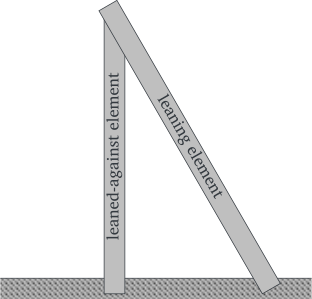
The leaned-against element is the primary indispensable element. It represents whom the sentence is about, i.e. its topic. The leaning element rests against the leaned-against element. It expresses some property about the leaned-against element that completes the meaning of the sentence.3
Once the two indispensable elements are in place, the sentence is leaned. Other dispensable elements (see section (ref) below) may be added in addition to the indispensable elements to add meaning to the sentence, but they are not required to make the sentence leaned.
Let’s look at the indispensable elements for the two types of Arabic sentences:
27.4.1 The indispensable elements of a nounal sentence
In a nounal sentence the subject is the leaned-against element and the info is the leaning element. Consider the following nounal sentence:
- زَيْدٌ قَائِمٌ
« Zayd is standing. »
DIAGRAM
Example (10) above is a nounal sentence. The subject زَيْدٌ is the leaned-against element. It is the topic of the sentence. The info قَائِمٌ is the leaning element. It is a comment on the topic, giving us some information about زَيْدٌ.
27.4.2 The indispensable elements of a verbal sentence
In a verbal sentence the verb is the leaning element and its doer is the leaned-against element. Consider the following verbal sentence:
- قَامَ زَيْدٌ
DIAGRAM
Example (11) above is a verbal sentence. The doer زَيْدٌ is the leaned-against element. It is the topic of the sentence. And the verb قَامَ is the leaning element. It is a comment on the topic.
27.5 Foundational government
In order to build a sentence from the indispensable elements, a sentence needs foundational government.4
Foundational government is any and all government prior to, and until, the first governed indispensable element. Foundational government may be of different types:
One of the two indispensable elements is the foundational government
In some sentences, the intitial governor may be one of the two indispensable elements. In example (11) above, the verb قَامَ governs its doer زَيْدٌ. The sc verb قَامَ has no case and thus needs no governor. So it is, itself, the foundational government.
DIAGRAM
Another (non-indispensable) element is the foundational government
The intitial governor may be internal to the sentence but not one of the two indispensable elements.
Here are some examples:
- لَمْ يَضْرِبِ الرَّجُلُ غُلَامَ زَيْدٍ [Owens, The foundations of grammar §2.2.3, 41]
« The man did not beat Zayd’s slave. »
DIAGRAM
- إِنَّ زَيْدًا قَائِمٌ
« Indeed Zayd is standing. »
DIAGRAM
The abstract foundational government
Very commonly, the foundational government is not an actual word, but only an abstract concept. When there is one or more caseful indispensable elements in a sentence with no overt (i.e. observable) governor, then this necessitates bringing in a abstract foundational government.5 For example:
- زَيْدٌ مُنْطَلِقٌ [Peled, Sentence types 87]
« Zayd is setting out. »
The abstract foundational government governs both the leaned-against element (the subject زَيْدٌ), and the leaning element (the info مُنْطَلِقٌ) in the u-case.
- يَقُومُ زَيْدٌ
« Zayd stands »
The abstract foundational government governs the leaning element (the pc verb يَقُومُ) in the u-case. And, as usual, the verb يَقُومُ governs its doer زَيْدٌ (the leaned-against element) in the u-case.
27.6 Dispensable elements
A dispensable element is any caseful element in a sentence, following the foundational government (in government hierarchy), that is not either of the two indispensable elements. The source of government for a dispensable element must be, directly or indirectly, one of the indispensable elements.
We know from section (ref) above, that in a nounal sentence the indispensable elements are the subject and the info. And that in a verbal sentence the indispensable elements are the verb and its doer. So all other elements besides these two, and elements that constitute the foundational government, are dispensable elements. Here is an (incomplete) list of some common dispensable elements:
- the attribute
- the direct doee (usually)
- the absolute doee (see chapter (ref))
- the adverb of time and the adverb of place (see chapter (ref))
- the adverb of reason (see chapter (ref))
- the accompanying doee (see chapter (ref))
- the ḥāl (see chapter (ref))
- the tamyīz (see chapter (ref))
By the way, when we say dispensable, we mean that an element is dispensable in the sense that it is not required to make the sentence leaned. We don’t mean that it is superfluous in terms of its meaning. In fact, a dispensable element may be essential for the correct meaning of the sentence. For example, consider the āyah:
- وَمَا خَلَقۡنَا ٱلسَّمَاۤءَ وَٱلۡأَرۡضَ وَمَا بَیۡنَهُمَا لَـٰعِبِینَ [سورة الأنبياء 21:16 cited by معاني النحو 1/14]
« And We did not create the heaven and earth and that between them in play. »
لَاعِبِينَ is a ḥāl (see in chapter (ref)), which is a dispensable element. If we remove it from the sentence, then the sentence will be leaned but it will have a grossly incorrect meaning.
27.7 Refining the definitions of the nounal sentence and the verbal sentence
We know that there are two basic types of Arabic sentences:
- The nounal sentence
- The verbal sentence
Previously we had said that a nounal sentence is one that begins with a noun. And a nounal sentence is one that begins with a verb. We will now refine these definitions, from the perspective of sentence completion:
A nounal sentence is one whose indispensable elements are two nouns: a subject (as the leaned-against element) and an info (as the leaning element). And a verbal sentence is one whose indispensable elements are a verb (as the leaning element) and and its doer (as the leaned-against element).
Consider, for example, the following sentence:
- بَلْ زَيْدٌ قَائِمٌ
« Rather Zayd is standing. »
The first word in the sentence above is بَلْ. It is a particle and not a indispensable element. Removing it from the sentence, we see that the remaining indispensable elements are two nouns: زَيْدٌ (the subject) and قَائِمٌ (as the info). So the sentence is a nounal sentence.
Let’s take a look at another example:
- زَيْدًا رَأَيْتُ [Peled, Sentence types 28]
« [It was] Zayd I saw. »
The first word in the sentence is زَيْدًا. It is a direct doee. We learned in section (ref) above that a direct doee is not usually a indispensable element. Rather, it is usually a dispensable element. Stripping the sentence of this dispensable element, we are left with رَأَيْتُ « I saw ». This is a verbal sentence. The verb رَأى is the leaning element and its doer, the pronoun تُ, is the leaned-against element.
Traditional definitions of the nounal sentence and the verbal sentence
The above re-definitions of the nounal sentence and the verbal sentence are from the perspective of sentence completion. There is no problem if we continue to use the original definitions in other spheres (as for example in Section 41.6.3). But we will still refine the traditional definitions to say:
A nounal sentence is one whose first indispensable element is a noun. And a verbal sentence is one whose first indispensable element is a verb.
27.8 Identifying the indispensable elements in a nounal sentence
It can sometimes be complicated to tell which of the twp indispensable elements in a nounal sentence is the leaned-against element and which is the leaning element. We will discuss several cases below:
27.8.1 When there is an overt foundational government
When there is an overt foundational government, like إِنَّ, كَانَ, etc., then it is usually easy to tell which is the leaned-against element and which is the leaning element. For example:
- فَإِنَّ حَسۡبَكَ ٱللَّهُ [سورة الأنفال 8:62]
« then sufficient for you is Allāh »
In example (19) above, حَسْب is in the a-case as the subject and the word ٱللَّهُ is in the u-case as the info. This tells us that حَسْب is the leaned-against element and the word ٱللَّهُ is the leaning element.
27.8.2 One indispensable element is definite and the other indispensable element is indefinite
When one indispensable element is definite and the other indispensable element is indefinite, then it is usually the case that the definite element is the leaned-against element (as the subject) and the indefinite element is the leaning element (as the info).
In terms of pragmatics, the leaned-against element and the leaning element represent ‘given’ and ‘new’ information. That is, the listener knows who the leaned-against element is and can identify him or it. So the leaned-against element is a ‘given’ to the listener. And the speaker is providing ‘new’ information about the leaned-against element to the listener. The definite element represents the ‘given’ information, which the listener already knows. And the indefinite element represents ‘new’ information.
Let’s take a look at an example:
- تَمِيمِيٌّ أَنَا [Peled, Sentence types 121]
« A Tamīmite I am. »
The pronoun أَنَا is definite. Therefore it is the leaned-against element (as the subject). And the word تَمِيمِيٌّ is indefinite. Therefore it is the leaning element (as the info). Example (20) is an inverted order sentence where the info is fronted and the subject is placed after it.
In special cases, some grammarians hold that it is possible to have an indefinite subject and a definite info.6 One special case is when a question noun is the subject. (Question nouns are considered indefinite.) For example:
كَمْ مَالُكَ [حاشية الصبان على شرح الأشمونى لألفية ابن مالك 1/231]
« How much is your wealth? »أَيُّ لَيْلَةٍ لَيْلَةُ الْقَدْرِ [جامع الترمذي :3513]
« Which night is the night of Decree »
Another special case is when the subject is an indefinite comparative noun in sentences like:
- خَيْرٌ مِنْكَ زَيْدٌ [حاشية الصبان على شرح الأشمونى لألفية ابن مالك 1/231]
« Better than you is Zayd »
In the above sentence, خَيْرٌ is considered the subject of the sentence.
27.8.3 Both indispensable elements are definite
When both indispensable elements are definite, then typically the first is the subject and the second is the info. For example:
- الدِّينُ النَّصِيحَةُ [صحيح مسلم :55a]
« The Religion is sincerity. »
However, if it is known from context that one if the two elements is the ‘given’ information and the other is the ‘new’ information, then the given information will be the subject and the new information will be the info, regardless of word-order.7
For example, consider a situation where one wishes to say, “Abū Yūsuf is [like] Abū Ḥanīfah.” (Imām Abū Yūsuf was the foremost student of Imām Abū Ḥanīfah.) The normal way to express this sentence is:
- أَبُو يُوسُفَ أَبُو حَنِيفَةَ [شرح ابن عقيل على الألفية 1/233]
« Abū Yūsuf is [like] Abū Ḥanīfah. »
DIAGRAM
However, if it is pragmatically known that the topic of the sentence is أَبُو يُوسُفَ, then it is ‘given’ that أَبُو يُوسُفَ is the leaned-against element (as the subject). Similarly, it is known that likening him to أَبُو حَنِيفَةَ is the ‘new’ information. Therefore, أَبُو حَنِيفَةَ is the leaning element (as the info). In this case, the sentence order can be flexible, and the info can be fronted (stylistically), for the same meaning, thus:
- أَبُو حَنِيفَةَ أَبُو يُوسُفَ
« [Like] Abū Ḥanīfah, Abū Yūsuf is. »
DIAGRAM
27.8.4 Both indispensable elements are indefinite
When both indispensable elements are indefinite then, again, the first is likely to be the subject and the second to be the info. Examples:
أَفْضَلُ مِنْ زَيْدٍ أَفْضَلُ مِنْ عَمْرٍو [شرح ابن عقيل على الألفية 1/232]
« [The person] better than Zayd is better than Ɛamr. »وَجَزَ ٰۤؤُا۟ سَیِّئَةࣲ سَیِّئَةࣱ مِّثۡلُهَاۖ [سورة الشورى 42:40]
« And the retribution for an evil act is an evil one like it »
27.9 The compound sentence
In a nounal sentence, the info is, by default, a single noun. See example (1) again:
- زَيْدٌ قَائِمٌ
« Zayd is standing. »
In example (1), قَائِمٌ is a single word and it is the info. This is what we may call a simple nounal sentence.
In contrast, in a compound nounal sentence, the info is itself a complete sentence. For example:
- زَيْدٌ يَقُومُ
« Zayd – he stands »
In example (29) above, زَيْدٌ is the subject and يَقُومُ is the info. But يَقُومُ is not a single word here. It is in fact a complete sentence. This is because, as we know, a verb must be followed by its doer. And if there is no overt doer, then a latent doer pronoun is implicated. So يَقُومُ is a a verbal sentence with the meaning « he stands ».
Here is example of a compound nounal sentence, whose info is also a nounal sentence:
- زَيْدٌ أَبُوهُ قَائِمٌ [التذييل والتكميل لأبي حيان 4/26]
« Zayd – his father is standing. »
(FIXME: MOVE THIS TO KAANA CHAPTER):
Compound sentences are very common with كَانَ. Remember from section (ref) above that كَانَ is a deficient verb, and thus needs a info to grammatically the sentence. This info may be a single word, like:
- كَانَ زَيْدٌ قَائِمًا
« Zayd was standing. »
Or the info of كَانَ may be a complete sentence:
- كَانَ زَيْدٌ يَقُومُ
« Zayd used to stand. »
(END FIXME)
The info of a compound nounal sentence is typically a truth-evaluable sentence. But it need not be so. A non-truth-evaluable sentence is also valid as a info8 For example:
- زَيْدٌ اضْرِبْهُ [التذييل والتكميل لأبي حيان 4/27]
« Zayd – hit him! »
(i.e. « Hit Zayd! »)
27.9.1 The government of the compound nounal sentence sentence
The info of a compound nounal sentence is a complete sentence. Therefore, it has its own independent internal government for all elements within it (including its own foundational government). But the entire info is governed, albeit not markedly, by a governor in the outer sentence. For example, consider the following compound nounal sentence:
- زَيْدٌ لَمْ يَضْرِبْ عَمْرًا
« Zayd – he did not hit Ɛamr »
In example (34) above, لَمْ يَضْرِبْ عَمْرًا is a complete sentence that is the info of the outer sentence. This inner sentence has its own internal government, starting with its foundational government لَمْ. The foundational government لَمْ governs the verb يَضْرِبْ in the ø-case. And the verb يَضْرِبْ governs an implicated latent doer pronoun (هُوَ) in the u-case, and the direct doee عَمْرًا in the a-case.
We will say that the inner sentence لَمْ يَضْرِبْ عَمْرًا is a positional u-case noun as the info of the outer sentence.
The government of this compound sentence is illustrated in the diagram below:
DIAGRAM
27.9.2 Invalid inner sentences
Some sentences are not valid as inner sentences:
27.9.3 The link between the inner and outer sentence
It is usually necessary for there to be a link between the inner sentence, and the subject of the outer sentence. This link is typically supplied by a pronoun. Let’s look at some examples:
- زَيْدٌ قَامَ أَبُوهُ [المقتصد للجرجاني 1/278]
« Zayd – his father stood up. »
DIAGRAM
In example (36) above, the link is the pronoun هُ in abuuhu.
- زَيْدٌ قَامَ [المقتصد للجرجاني 1/278]
« Zayd – he stood up. »
DIAGRAM
In example (37) above, the link is the implied singular masculine pronoun that is the doer of قَامَ.
Generally, if there is no such link between the inner sentence and the subject of the outer sentence, then the compound sentence is invalid.^[Peled, Sentence types 94 citing شرح ابن يعيش على المفصل; المقتصد للجرجاني] So we cannot say, for example:
- ✗ زَيْدٌ قَامَ عَمْرٌ [Peled, Sentence types 94 citing شرح ابن يعيش على المفصل]
« Zayd – Ɛamr stood up »
A pointing noun as the link
Instead of a pronoun, an pointing noun may serve as the link. For example:
- وَلِبَاسُ ٱلتَّقۡوَىٰ ذَ ٰلِكَ خَیۡرࣱۚ [سورة الأعراف 7:26 cited by شرح ابن عقيل على الألفية 1/204]
« But the clothing of righteousness - that is best. »
A repeated subject as the link
The subject of the outer sentence may be repeated in the inner sentence, and this is sufficient as the link. For example:
- ٱلۡحَاۤقَّةُ ١ مَا ٱلۡحَاۤقَّةُ ٢ [سورة الحاقة 69:1–2 cited by شرح ابن عقيل على الألفية 1/204]
« The Inevitable Reality - What is the Inevitable Reality? »
No need for the link
In cases where the info of the outer sentence is more general than its subject a link is not needed. For example:
- زَيْدٌ نِعْمَ الرَّجُلُ [Wright 2/256D, شرح ابن عقيل على الألفية 1/204]
« Zayd – an excellent man »
The link is also not needed when the subject of the outer sentence and its info are perfectly identical in meaning. For example:
نُطْقِي اللَّهُ حَسْبِي [Wright 2/256D, شرح ابن عقيل على الألفية 1/204]
« My utterance is “Allāh is sufficient for me.” »قَوْلِي لَا إِلَهَ إِلاَّ اللَّهُ [Wright 2/256D, شرح ابن عقيل على الألفية 1/204]
« My saying is “There is no god but Allāh.” »
An implied link
The link, even when technically required, is sometimes omitted. But it remains implied. This is in cases in which the sense is perfectly clear without it.11 For example:
- ٱلسَّمْنُ مَنَوَانِ بِدِرْهَمٍ [Wright 2/256C; المقتصد للجرجاني 1/278; شرح الرضي على الكافية 1/238]
« The ghee is (at the rate of) two manās for a dirham. »
In the example above, the sentence with the link restored is ٱلسَّمْنُ مَنَوَانِ مِنْهُ بِدِرْهَمٍ « two manās of it for a dirham. »
27.10 Other complete sentences in place of nouns
It is not only the info which can be replaced with a complete sentence. Other grammatical categories are also, by default, a single noun, but which can be replaced with complete sentences. We will discuss some of these categories below, and treat other categories in their respective chapters (like the ḥāl, the condition-response, and verbs of perception).
27.10.1 The direct doee as a complete sentence
A sentence which is direct speech occurs in the place of a direct doee. For example:
- قَالَ إِنِّی عَبۡدُ ٱللَّهِ [سورة مريم 19:30 cited by شرح شيخ زاده على قواعد الإعراب 1/23]
« [Jesus] said, “Indeed, I am the servant of Allāh. »
In the example above, the sentence إِنِّی عَبۡدُ ٱللَّهِ is in place of the a-case direct doee of قَالَ.
A complete sentence can also occur as a direct doee with verbs of perception. Examples:
- ظَنَنْتُ زَيْدًا يَقْرَأُ [شرح شيخ زاده على قواعد الإعراب 1/24]
« I believed Zayd [to be] reading. »
In the example above, the verbal sentence يَقْرَأُ is in place of the a-case direct doee of ظَنَنْتُ. We will learn more about this category in chapter (ref), if Allāh wills.
27.10.2 The attribute as a complete sentence
The attribute is, in principle, a single noun.
However, an sentence entire sentence may occur in place of the single noun. For example, instead of saying مَرَرْتُ بِرَجُلٍ قَائِمٍ, we can replace the single word attribute قَائِمٍ with the sentence يَقُومُ, thus:
- مَرَرْتُ بِرَجُلٍ يَقُومُ [الإيضاح للفارسي 308]
« I passed by a man [that] stands. »
(literally: « I passed by a ‘he stands’ man. »
Note that the pc verb يَقُومُ is in the u-case. This is because يَقُومُ is a complete sentence (with an implied doer pronoun). So it has its own internal government that is not affected by any element in the outer sentence. Thus, the case of the attributee رَجُلٍ has no effect on any case within the sentence-attribute. However, the entire sentence attribute is in place of a i-case noun as the attribute of رَجُلٍ.
Substituing a single-noun attribute with its corresponding pc verb is the most basic form of the sentence-attribute. However, more complex sentence-attributes may also be formed. For example:
- وَٱتَّقُوا۟ یَوۡمࣰا تُرۡجَعُونَ فِیهِ إِلَى ٱللَّهِۖ [سورة البقرة 2:281 cited by أوضح المسالك لابن هشام 3/276]
« And fear a Day when you will be returned to Allāh. »
In example (48) above, the sentence تُرۡجَعُونَ فِیهِ إِلَى ٱللَّهِ is a attribute of يَوْمًا.
There are three conditions that must be met in order for a sentence to occur as a attribute^: [أوضح المسالك لابن هشام 3/275–278]
- The attributee must be indefinite, either in wording or in meaning.
- The sentence-attribute must contain a link that links back to the attributee.
- The sentence-attribute should be truth-evaluable.
Let’s discuss each of these conditions.
Indefiniteness of the attributee
We already saw an example of an indefinite (in wording) attributee in example (48) above. Here is an example of a attributee which is definite in wording, but indefinite in meaning:
- وَلَقَدْ أَمُرُّ عَلَى اللَّئِيمِ يَسُبُّنِي [أوضح المسالك لابن هشام 3/276]
« And indeed I pass by the ignoble [person that] insults me »
In example (49) the attributee اللَّئِيمِ is referring to a general person, and is therefore indefinite in meaning.
A link that links back to the attributee
In example (48), the link, which links back to the attributee يَوْمًا, is the pronoun ه in فِيهِ.
Sometimes the link is not explicit, but is implied. For example:
- وَٱتَّقُوا۟ یَوۡمࣰا لَّا تَجۡزِی نَفۡسٌ عَن نَّفۡسࣲ شَیۡـࣰٔا [سورة البقرة 2:123 cited by أوضح المسالك لابن هشام 3/277]
« And fear a Day when no soul will suffice for another soul at all »
The implied link is the pronoun ه in an implied فِيهِ, i.e. لَا تَجْزِی فِيهِ.
The sentence-attribute should be truth-evaluable
The following sentence is impermissible because the attribute اضْرِبْهُ is a non-truth-evaluable sentence.
- ✗ مَرَرْتُ بِرَجُلٍ اضْرِبْهُ [أوضح المسالك لابن هشام 3/278]
« I passed by a man – hit him »
27.10.3 The annexed-to noun in an annexation as a complete sentence
The annexed-to noun in an annexation may be a complete sentence instead of a single noun. For example:
- هَـٰذَا یَوۡمُ یَنفَعُ ٱلصَّـٰدِقِینَ صِدۡقُهُمۡۚ [سورة المائدة 5:119 cited by شرح شيخ زاده على قواعد الإعراب 1/28]
« This is the Day when the truthful will benefit from their truthfulness. »
In example (52) above the entire sentence یَنفَعُ ٱلصَّادِقِینَ صِدْقُهُمْ is the annexed-to noun to the annexed noun يَوْمُ. As with sentence-infos and sentence-attributes, the sentence-annexed-to noun has its own internal government. And the sentence-annexed-to noun is in place of an i-case noun.
Here is another example:
- یَوۡمَ هُم بَـٰرِزُونَۖ [سورة غافر 40:16 cited by شرح شيخ زاده على قواعد الإعراب 1/29]
« The Day they come forth »
27.11 A foreign element separating a governor from its governee
A foreign element, with respect to a particular governor, is one that is not directly governed by the governor. In most cases, a foreign element should not come between (and thus separate) a governor from its governee(s). For example, consider the following sentence:
- عَلِمْتُ مُحَمَّدًا يُؤَلِّفُ كِتَابًا [الجملة العربية لفاضل السامرائي 66]
« I knew Muḥammad [to be] writing a book. »
In the example above the verbal sentence يُؤَلِّفُ كِتَابًا is in place of the second direct doee of عَلِمْتُ. The noun كِتَابًا is governed directly by the verb يُؤَلِّفُ. So كِتَابًا is a foreign element for the verb عَلِمْتُ. Therefore, كِتَابًا should not come between the governor عَلِمْتُ and its governee مُحَمَّد. So the following sentence would be impermissible:
- ✗ عَلِمْتُ كِتَابًا مُحَمَّدًا يُؤَلِّفُ [الجملة العربية لفاضل السامرائي 66]
27.12 The state-of-affairs pronoun
Usually, for pronouns, the pronoun’s referent is a single noun that occurs before it. For example, if we say
- زَيْدٌ هَوَ مُنْطَلِقٌ
« Zayd is setting out. »
Then the pronoun هُوَ refers to the noun زَيْدٌ which occurs before it.
There is a special pronoun, called the state-of-affairs pronoun (ضَمِيرُ الشَّأْنِ) that behaves differently from other pronouns. It is used to begin compound nounal sentences. Here is an example of a sentence with a state-of-affairs pronoun:
- هُوَ زَيْدٌ مُنْطَلِقٌ [معاني النحو 1/57]
« [The state of affairs] is: Zayd is setting out. »
The pronoun هُوَ in example () above is the state-of-affairs pronoun It is the subject of the outer sentence. Its info is the inner sentence زَيْدٌ مُنْطَلِقٌ. What the state-of-affairs pronoun is referring to is explained by the entire sentence زَيْدٌ مُنْطَلِقٌ that occurs after it.
The state-of-affairs pronoun is typically used for statements that are momentous. Consider, for example, a situation where one hears some hubbub, and wonders, « What is the state of affairs that is causing this hubbub?12 » The answer to this question is:
- هُوَ الأَمِيرُ مُقْبِلٌ [شرح الرضي على الكافية 2/464]
« It is: the commander is approaching. »
(the pronoun “it” is referring to “the state of affairs”.)
In English, one might hear this sort of sentence expressed as: « The thing is: the commander is approaching. » Usually though, this pronoun is left untranslated. So example (58) may simply be translated as « The commander is approaching. »
Here are some rules and guidelines regarding the state-of-affairs pronoun:
The gender of the state-of-affairs pronoun
If the subject of the following sentence is masculine, then the state-of-affairs pronoun is generally the masculine pronoun هُوَ. And if the subject of the following sentence is feminine, then the state-of-affairs pronoun is generally the feminine pronoun هِيَ. Examples:
هُوَ زَيْدٌ قَائِمٌ [البسيط لابن أبي الربيع 745]
« [The state of affairs] is: Zayd is standing. »هِيَ هِنْدٌ قَائِمَةٌ [البسيط لابن أبي الربيع 745]
« [The state of affairs] is: Hind is standing. »
Sometimes, however, the gender of the state-of-affairs pronoun can mismatch the gender of the following subject. For example:
هِيَ زَيْدٌ قَائِمٌ [البسيط لابن أبي الربيع 745]
« [The state of affairs] is: Zayd is standing. »هُوَ هِنْدٌ قَائِمَةٌ [البسيط لابن أبي الربيع 745–756]
« [The state of affairs] is: Hind is standing. »
The state-of-affairs pronoun is always a singular pronoun
The state-of-affairs pronoun is always a singular pronoun, regardless of whether the subject of the following subject is singular, dual, or plural.13
هُوَ الزَّيْدَانِ قَائِمَانِ
« [The state of affairs] is: the two Zayds are standing. »هِيَ الْهِنْدَاتُ قَائِمَاتٌ
« [The state of affairs] is: the Hinds are standing. »
The state-of-affairs pronoun is always a pronoun for the absentee person
Even if the subject of the inner sentence is a pronoun for the speaker or adressee persons, the state-of-affairs pronoun is always a pronoun of for the absentee person. For example:
- هُوَ أَنَا زَيْدٌ [معاني النحو 1/59]
« [The fact] is: I am Zayd. »
The sentence أَنَا أَنَا زَيْدٌ is possible, but in this case the pronoun أَنَا is not a state-of-affairs pronoun. Rather it is repeated for emphasis.14
The state-of-affairs pronouns هُوَ and هِيَ only introduce nounal sentences
The state-of-affairs pronouns هُوَ and هِيَ only introduce nounal sentences.15 This can be seen in the examples above.
We will see, in sections (kaana) and (inna), that the state-of-affairs pronoun can also be used with كَانَ and إِنَّ (and its sisters). In these cases, the state-of-affairs pronoun may introduce verbal sentences. For example:
- فَإِنَّهَا لَا تَعۡمَى ٱلۡأَبۡصَـٰرُ [سورة الحج 22:46 cited by شرح الرضي على الكافية 2/467]
« For indeed, it is not eyes that are blinded »
27.13 Deletion
Al-Liheibi, Aspects of sentence analysis in the Arabic linguistic tradition Chapter 5
In Arabic, a part of a sentence may be deleted. There are three types of deletion:
- Mandatory deletion
- Regular deletion
- Optional deletion
Lines are blurred. حتى أن is shaadh.
General rule: optional deletion only allowed when listener can reconstruct the deleted elements.
27.14 positional case
في محل رفع/نصب/جزم
TODO
Hickey, L, “Stylistics, Pragmatics, and Pragmastylistics”↩︎
Wright 2/250ff; الجملة العربية لفاضل السامرائي 13ff↩︎
See also Talmon, “Musnad, musnad ilayhi and the early history of Arabic grammar: A reconsideration”↩︎
See Owens, The foundations of grammar §2.3.6.1, 54↩︎
Owens, The foundations of grammar 55; Peled, Sentence types 87–88↩︎
https://alababmisr.com/%D8%B3%D8%A4%D8%A7%D9%84-%D9%87%D9%84-%D9%8A%D8%AC%D9%88%D8%B2-%D8%A3%D9%86-%D9%8A%D8%A3%D8%AA%D9%8A-%D8%A7%D9%84%D9%85%D8%A8%D8%AA%D8%AF%D8%A3-%D9%86%D9%83%D8%B1%D8%A9-%D9%88%D8%A7%D9%84%D8%AE/↩︎
شرح جمل الزجاجي لابن عصفور 1/347; التذييل والتكميل لأبي حيان 4/27↩︎
التذييل والتكميل لأبي حيان 4/28↩︎
التذييل والتكميل لأبي حيان 4/28↩︎
Wright 2/256B↩︎
شرح الرضي على الكافية 2/464↩︎
شرح الرضي على الكافية 2/467↩︎