26 The Arabic grammatical tradition
THIS BOOK IS A WORK IN PROGRESS. IT IS INCOMPLETE AND MAY HAVE TYPOGRAPHICAL AND OTHER ERRORS. IT IS NOT YET READY TO BE STUDIED FROM.
26.1 History of the Arabic grammatical tradition
During the time of the Prophet ﷺ, the Arabs spoke Classical Arabic natively.
After the time of the Prophet ﷺ, during the Rās͡hidūn caliphate (11–41 ah), the borders of the Islāmic state had expanded beyond the Arabian peninsula. This brought upon an increased intermingling between Arab and non-Arab populations, especially in the towns and urban centers.
There are reports that, during this time, there was an increased occurrence of grammatical and pronunciation errors in spoken Arabic, especially by non-Arabs and the newer generation.1
The reports also claim, that in order to safeguard the Qurʾān from being read incorrectly, efforts began to preserve Classical Arabic. This outline of events is traditionally credited as the inception of the Arabic grammatical tradition, and of the profession of the grammarian. Another reason that may have propelled grammatical activity may have been a desire to understand how to correctly produce speech modeled on Classical Arabic.2
It is difficult to establish the authenticity of many of the reports which list specific individuals and incidents that purportedly launched Arabic grammar as a discipline.3 So we are not certain who would qualify to be the very first grammarians, nor are we certain of the extent of their grammatical discourse. We do know that the early grammarians of the first and early second centuries ah, were definitely able to distinguish between correct and incorrect language.4 But their terminology and grammatical analysis were presumably rudimentary.5
However, in the latter half of the second century ah, Arabic grammar had already developed, from these primitive beginnings, into a highly developed system of linguistic analysis.6
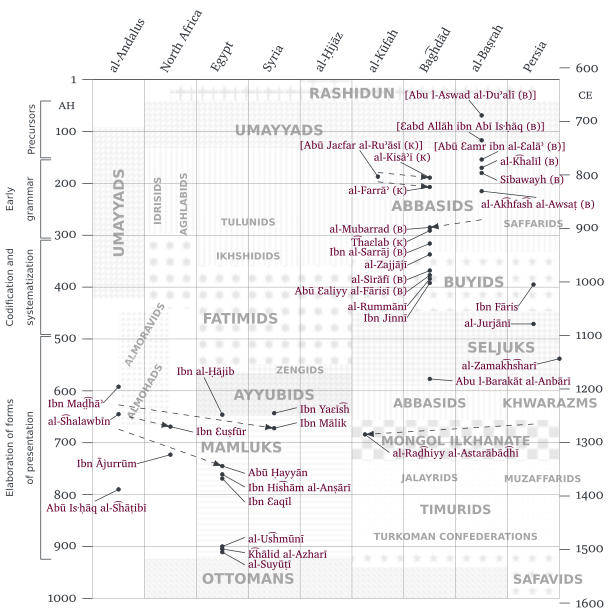
Initially, in the second century ah, grammatical activity was centered mainly in two places: the cities of al‑Baṣrah and al‑Kūfah, in Iraq.7 By middle of the third century ah, these Baṣran and Kūfan schools had eventually moved to the Abbasid capital Bag͡hdād. After the fourth century ah, the grammarians were more geographically widespread, with many famous later grammarians operating out of Egypt, Syria, Persia, and al‑Andalus (Islāmic Spain).
Figure 26.1 depicts a (year of death) timeline and geographical distribution of some of the more well-known Arabic grammarians.
26.2 Attested usage
In order to develop a grammatical framework for Classical Arabic, the grammarians first needed a collection of authentic Classical Arabic texts. The grammarians used, as their source material for this collection, a corpus of Classical Arabic texts, which we will term attested usage. The body of attested usage can be categorized into9:
- Transmitted texts. These include:
- Authorized readings of the Qurʾān
- Poetry of the pre-Islāmic and early Islāmic poets
- A collection of the sayings and proverbs of the Arabs
- the Ḥadīt͡h
- Elicited speech
We will discuss these categories below:
The Qurʾān
The Qurʾān was transmitted by the Prophet ﷺ to his Companions. When the territories under the Islāmic caliphate expanded, many of the Companions were sent or relocated to the different areas under Muslim rule, and there, they began teaching the Qurʾān to their students from the Tābiɛīn. Those students taught it to the next generation and so on and so forth. The text of the Qurʾān was thus available to the grammarians and used by them as a primary linguistic source.10
Poetry
From pre-Islāmic times into the Islāmic era, Classical Arabic poetry was composed and transmitted orally, from region to region, and from generation to generation. The grammarians used this transmitted poetry as their second major source of transmitted data.11
Some native Arabic dialects were beginning to diverge from Classical Arabic in the first and second century ah. Because of this, the grammarians were more discerning in whether they would accept the poetry of a later poet. Generally they would only accept the poetry of a later poet if his language was determined to be uninfluenced by the newer developments in the native dialects. The grammarians generally have a cut-off date somewhere in the middle of the second century ah. Poetry composed after this cut-off date is typically not accepted as a valid source of Classical Arabic.12
Sayings and proverbs of the Arabs
A small portion of prose material, consisting of sayings and proverbs of the Arabs, is also generally accepted as a source of Classical Arabic data.13
The Ḥadīt͡h
The Ḥadīt͡h of the Prophet ﷺ were transmitted by his Companions to their students from the Tābiɛīn, who then transmitted them to their students from the next generation, and so on. Theoretically, the Ḥadīt͡h texts should be considered a valid source of Classical Arabic. However, as a trend, the grammarians were reluctant to consider the transmitted Ḥadīt͡h texts as part of attested usage. This is because they feared that some of the narrators in the chains of transmission of ḥadīt͡h may have narrated their ḥadīt͡h by meaning, rather than verbatim text. And if the narrator was himself not a native Classical Arabic speaker, then the grammarians could not be certain that the ḥadīt͡h that reached them was correct Classical Arabic. They did not have this view regarding the Qurʾān and poetry because the Qurʾān and poetry required that they be transmitted verbatim.
This policy of the grammarians has received some criticism, with some researchers deeming that they were unnecessarily exclusive, and that if the transmitters of a ḥadīt͡h are deemed competent, then the ḥadīt͡h should be admitted into attested usage. In this sense, Ḥadīt͡h texts should be considered at least as acceptable as poetry, since the possibility of variation in transmission is applicable to both. In any case, we note that if the grammarians erred then it was on the side of caution.14
Elicited speech
In addition to the transmitted texts mentioned above, the grammarians also used, as part of their source data, samples of speech that they obtained themselves by meeting and talking to native Classical Arabic speaking informants. Such informants continued to exist, in pockets, into the second and third centuries ah. In general, the speech of the bedouin Arabs was considered purer and more free from errors than that of the urban population. The grammarians would seek out such informants, listen to their ordinary speech in natural settings, and also ask them questions, the answers to which would betray insight into the grammatical issues that they were investigating.15
Exclusion of the grammarians’ writings from attested usage
The grammarians were scholars of Classical Arabic. Yet, generally speaking, they were not native speakers of Classical Arabic. So even though they were knowledgeable in analyzing Classical Arabic, they had not learned it natively. So their writings are not considered attested usage.16 Excepted are examples that the grammarians made up and adduced to explain a particular grammatical issue.17 Those are admitted into attested usage, though subject to critique by other grammarians.18
26.3 Analogy and grammatical reason
Once the source material from attested usage was available to the grammarians, they set about analyzing it in order to develop a grammatical framework The process of developing a grammatical framework is based on analogy and grammatical reason.
Analogy is the process of observing a pattern in attested usage, determining a grammatical reason for the pattern, and expounding a grammatical rule that states that whenever the grammatical reason is found, then the pattern is to be expected.19
Let’s explain what we mean.
Let’s say, hypothetically, a grammarian goes through the data in attested usage, and comes across sentences like:
جَاء الرَّجُلُ
« The man came. »ضَرَبَ زَيْدٌ عَمْرًا
« Zayd beat Ɛamr. »يَدْخُلُ الْبَيْتَ رَجُلٌ
« A man enters the house. »لَنْ يَضِيعَ الْعَمَلُ الصَّالِحُ
« The good deed shall not go waste. »لَمْ تَذْهَبْ هِنْدٌ
« Hind did not go. »
When the grammarian studies these sentences he notes that they are all verbal sentences consisting of (at least) a verb and its doer. He also observes a pattern. And that is that the doer of the verb is always in the u-case. Now, he comes up with a grammatical rule that states that whenever there is a verbal sentence (this is our grammatical reason), then the doer of the verb is be in the u-case.
This rule is made for the benefit of the student who has not gone through the data in attested usage. Let’s say that a student is reading a text and comes across a sentence:
- ضَرَبَ عَمْرًا زَيْدٌ
« Zayd beat Ɛamr. »
The student determines that this is a verbal sentence. Being a verbal sentence is the grammatical reason that makes the above analogy-based rule applicable. Now the student observes that ضَرَبَ is the verb, and following it are two nouns: عَمْرًا in the a-case, and زَيْدٌ in the u-case. Applying the rule, he detrmines that the person who did the beating is Zayd, not Ɛamr. This will give him a correct understanding of the text.20
Furthermore, if the student wishes to construct his own verbal sentence, attempting to conform to sca, then he knows that he will have to put the verb’s doer in the u-case.
26.4 Anomalous usage
Sometimes a pattern occurs often enough in attested usage that a rule is built upon it using analogy. However, occurrences contrary to the pattern are also found in attested usage. This usage which is contrary to analogy is called anomalous usage.
Let’s take a look at an example of anomalous usage. When the second letter of a root is و, then its stem-10 sc verb is regularly formed by transforming the و into an alif. This is done according to analogy. For example:
| Root | stem-10 sc verb |
|---|---|
| قوم | اسْتَقَامَ « to be steadfast » |
| عوذ | اسْتَعَاذَ « to seek refuge » |
| نور | اسْتَنَارَ « to seek light » |
In anomalous usage, a few roots whose middle letters are و, usually form their stem-10 sc verbs by keeping the و. For example:
| Root | stem-10 sc verb |
|---|---|
| حوذ | اسْتَحْوَذَ « to gain mastery, overcome » |
| صوب | اسْتَصْوَبَ « to consider (هـ s.th) to be right » |
By the way, اسْتَحَاذَ and اسْتَصَابَ are also found in attested usage, albeit less frequently.
The general principle, when dealing with anomalous usage, is that it should be limited to what is found in attested usage, and not be extended by analogy.
So the rule for forming stem-10 sc verb for roots that have و as the middle letter, is that the verbs should be formed generally by transforming the و into an alif, like اسْتَقَامَ and اسْتَعَاذَ. But for the few verbs that fall into anomalous usage, we should prefer to keep the و, thus: اسْتَحْوَذَ and اسْتَصْوَبَ. The forms اسْتَحَاذَ and اسْتَصَابَ are permissible but less preferred.21
The grammarians have not always agreed over how to deal with different anomalous usages. As an example, when an adjectival noun is on the pattern أَفْعَل, like أَبْيَض « white » and أَسْوَد « black », then a comparative noun for it on the same pattern أَفْعَل is regularly not found to be used in attested usage. So أَبْيَض is not usually found in attested usage to mean « more white ». However, this meaning is found as anomalous usage, as in the verse of poetry:
- جَارِيَةٌ فِي دِرْعِهَا الفَضْفَاضِ ~ أَبْيَضُ مِنْ أُخْتِ بَنِي إِبَاضِ [القياس في اللغة العربية لمحمد الخضر حسين 42]
« A girl in her full long shirt ~ whiter than a [woman of the tribe] of Banū Ibād̤͡h »
Some grammarians were of the opinion, that because of the usage of أَبْيَض in the above verse to mean « whiter », this can be extended by analogy generally. So whenever a adjectival noun is on the pattern أَفْعَل, a comparative noun can also be formed for it on the same pattern. Other grammarians were more conservative and did not extend this usage by analogy.22
26.5 The balance between analogy and attested usage
The ultimate authority for what is correct Classical Arabic is attested usage. Analogy-based rules are a means to understand sca correctly, and a guide to form sentences that attempt to conform to sca.
Analogy is a speculative process on the part of the grammarians.23 As such, it is subjective, and rules derived from analogy may need to be revised and refined in order to sufficiently explain the language. Natural language, however, is very complex and analogy-based rules, even if continually revised and refined, can perhaps never capture its full complexity.
Because of this, attested usage, in general, should not be rejected on the basis of analogy. And an analogy, even if it were sound, should not be applied if it leads to something that is contrary to attested usage.24
26.6 Classical Arabic dialects and sca
Classical Arabic consisted of multiple dialects that were spoken by the various tribes of the Arabs in the different regions of the Arabian peninsula. Even within a dialect, there were often multiple ways of choosing and forming words and expressions. When the grammarians described the Arabic of attested usage, they would typically list many of the linguistic variations found within and across the different dialects of Classical Arabic. When Standard Classical Arabic (sca) emerged as literary standard, it converged to using only a small subset out of the many variations allowed in Classical Arabic.
We will discuss below a few examples out of the many variations of Classical Arabic, and the selections which became standardized in sca25:
Pluralizing the verb with a plural doer
The grammarians discuss a dialectal feature where a verb is pluralized even when it has a overt plural doer noun. So speakers of this dialect would say:
- ضَرَبُونِي قَوْمُكَ [كتاب سيبويه 2/40]
« Your people beat me. »
instead of the more normative:
- ضَرَبَنِي قَوْمُكَ
The dialectal feature used in example (8) is graded by the grammarians as rare.26 It did not make its way into sca. Instead, the more common usage in example (9) became the standard.
Elision of the hamzah
Hamzah was considered by the grammarians to be an original root letter. So for example, it is an original root letter in رَأْس raʾs “« head »”. However, the preferred pronunciation of native Classical Arabic speakers in some regions was to elide or approximate it in favor of a vowel, or the letters و or ي, depending on the surrounding vowels.27 So they would say رَاس rās instead of رَأْس raʾs.28 This variant pronunciation was not generally adopted in sca, which retains the full pronunciation of hamzah for most words.
Matching ك in the far pointing nouns to the gender and number of the persons being spoken to
Classical Arabic had a feature, where the end ك in a far pointing noun could optionally be feminized, dualized, or pluralized, to match the number and gender of the persons being spoken to.29 For example:
- وَنَادَىٰهُمَا رَبُّهُمَاۤ أَلَمۡ أَنۡهَكُمَا عَن تِلۡكُمَا ٱلشَّجَرَةِ وَأَقُل لَّكُمَاۤ إِنَّ ٱلشَّیۡطَـٰنَ لَكُمَا عَدُوࣱّ مُّبِینࣱ [سورة الأعراف 7:22]
« And their Lord called to them, “Did I not forbid you from that tree and tell you that Satan is to you a clear enemy?” »
This feature tends to not be used in sca.
Variations in the pointing nouns
Classical Arabic had a large variety of pointing nouns. For example, “« that1f »” was expressed using both تِلْكَ tilka and تِيكَ tīka. sca uses only تِلْكَ tilka. Here is an example:
- إِنَّمَا يَدْخُلُ عَلَىَّ رَسُولُ اللَّهِ صلى الله عليه وسلم فَيُسَلِّمُ ثُمَّ يَقُولُ كَيْفَ تِيكُمْ ثُمَّ يَنْصَرِفُ [صحيح البخاري :4750]
« The Messenger of Allāh ﷺ would only enter upon me, greet, then say, “How is that [lady]?” Then he would leave. »
Similarly, Classical Arabic expressed “« there »” using both هُنَاكَ and هُنَالِكَ. In sca, only هُنَاكَ tends to be used, whereas هُنَالِكَ is hardly ever used.
The imālah
For some words that have a final ىٰ, and also for some long ā vowels in the middle of a word, some tribes would pronounce the vowel as ē, not ā. This vowel sound is known as imālah.
Here are a couple of words with imālah and with the sca pronunciation:
| Word | sca pronunciation | pronunciation with imālah |
|---|---|---|
| حُبْلَىٰ30 | ḥublā | ḥublē |
| مَسَاجِد31 | masājid | masējid |
The imālah can be heard in the Qurʾānic reading of Ḥafṣ ɛan Ɛāṣim in this āyah:
- وَقَالَ ٱرۡكَبُوا۟ فِیهَا بِسۡمِ ٱللَّهِ مَجۡرٜىٰهَا وَمُرۡسَىٰهَاۤۚ إِنَّ رَبِّی لَغَفُورࣱ رَّحِیمࣱ [سورة هود 11:41]
« And [Noah] said, “Embark therein; in the name of Allāh [are] its course and its anchorage. Indeed, my Lord is Forgiving and Merciful.” »
The imālah is not used in sca.
The vowel on the attached pronouns ه/هما/هم
We have learned that when the attached pronouns ه/هما/هم are preceded by a kasrah, long-ī, or ay, then, in sca, the ه gets a kasrah instead of a d̤͡hammah. For example: بِهِ bihī, عَلَيْهِمَا ɛalayhimā, فِيهِمْ fīhim. In Classical Arabic, the dominant pronunciation in some regions was to retain the d̤͡hammah on the ه regardless of the preceding vowel. So, for example, they would say بِهُ bihū.32 This variant can be heard in the Qurʾānic reading of Ḥafṣ ɛan Ɛāṣim in this āyah:
- وَمَنۡ أَوۡفَىٰ بِمَا عَـٰهَدَ عَلَیۡهُ ٱللَّهَ فَسَیُؤۡتِیهِ أَجۡرًا عَظِیمࣰا [سورة الفتح 48:10]
« And he who fulfills that which he has promised Allāh - He will give him a great reward. »
وَهْوَ, فَهْوَ, etc.
When the conjunction وَ or فَ is attached to the pronouns هُوَ and هِيَ then Classical Arabic would optionally pronounce them as فَهْوَ fahwa (instead of فَهُوَ fahuwa), وَهْيَ wahya (instead of وَهِيَ wahiya), etc.33 For example:
- عَنْ أَبِي هُرَيْرَةَ، أَنَّ رَسُولَ اللَّهِ صلى الله عليه وسلم ذَكَرَ يَوْمَ الْجُمُعَةِ فَقَالَ فِيهِ سَاعَةٌ لاَ يُوَافِقُهَا عَبْدٌ مُسْلِمٌ، وَهْوَ قَائِمٌ يُصَلِّي، يَسْأَلُ اللَّهَ تَعَالَى شَيْئًا إِلاَّ أَعْطَاهُ إِيَّاهُ [صحيح البخاري :935]
« On the authority of Abū Hurayrah, Allāh’s Messenger ﷺ mentioned the day of Friday and said, “There is an hour on Friday in which no Muslim servant stands praying and asks Allāh for something except that He will grant it to him.” »
sca does not typically use this option.
هَرَاقَ and أَهْرَاقَ instead of أَرَاقَ
In Classical Arabic the stem-4 verb أَرَاقَ يُرِيقُ « to pour, spill » had variants: هَرَاقَ يُهَرِيقُ and أَهْرَاقَ يُهْرِيقُ. For example:
- فَإِنْ أَصْبَحَ مِنْهُ شَىْءٌ أَهْرَاقَهُ [سنن النسائي :5739]
« If anything was left of it the following morning he poured it out. »
These variants are not used in sca.
The u-case-ن of the pc verb
There are five pc verbs for which the u-case is indicate using a ن. They are:
- يَفْعَلُونَ « they3m »
- تَفْعَلُونَ « you3m »
- يَفْعَلَانِ « they2m »
- تَفْعَلَانِ « they2f/you2 »
- تَفْعَلِينَ « you1f »
In Classical Arabic, the ن could occasionally be dropped, even for the u-case.34 For example:
- وَالَّذِي نَفْسِي بِيَدِهِ لاَ تَدْخُلُوا الْجَنَّةَ حَتَّى تُؤْمِنُوا وَلاَ تُؤْمِنُوا حَتَّى تَحَابُّوا [جامع الترمذي :2688]
« By the One in Whose Hand is my soul! You will not enter Paradise until you believe, and you will not believe until you love one another. »
The ن is not dropped in sca for the u-case.
In addition, when these verbs have a speaker-participant pronoun as its direct doee, then Classical Arabic had three acceptable forms35:
- يَفْعَلُونَنِي yafɛalūnanī
- يَفْعَلُونِّي yafɛalūnnī
- يَفْعَلُونِي yafɛalūnī
Option (ii) can be heard in the Qurʾānic reading of Ḥafṣ ɛan Ɛāṣim in this āyah:
- قُلۡ أَفَغَیۡرَ ٱللَّهِ تَأۡمُرُوۤنِّیۤ أَعۡبُدُ أَیُّهَا ٱلۡجَـٰهِلُونَ [سورة الزمر 39:64]
« Say, [O Muḥammad], “Is it other than Allāh that you order me to worship, O ignorant ones?” »
sca uses only option (i).
Summary
Classical Arabic possessed a wide and dynamic range of linguistic features during the period when it was still spoken as a native language.
sca, by contrast, emerged later as a codified literary variety, after Classical Arabic had largely ceased to function as a mother tongue. As a result, sca draws on only a portion of the variation that once characterized Classical Arabic. For each linguistic feature, the portion selected by sca often, but not always,36 corresponds to what the grammarians identified as the base or archetypal form, from which other variations would branch out. Alternative forms and patterns, once fully natural and widely used, fell into disuse as sca became crystallized.
By the way, some of the features discussed above, like the elision of the hamzah, the imālah, and variation in the pointing nouns (amongst others), are heard to this day in some of the modern vernacular dialects. This is hardly surprising since they are the product of natural evolution from the Classical Arabic dialects.
It must be stressed that the variations found in attested usage are, generally, all valid Classical Arabic. One cannot take the selection that is used in sca and, on its basis, pronounce judgement on a non-conforming feature that is found in attested usage.
26.7 Taqdīr
When the grammarians were analyzing attested usage, they observed that there is an underlying harmony and order in the Classical Arabic language,37 such that it could be described with a set of coherent and comprehensive basic principles. But these principles often will not describe surface speech directly. Surface speech is defined as the actual utterance that is spoken by the speaker and heard by the listener. This is because surface speech, even when not anomalous usage, has too much variation and complexity to be wrangled into a minimalist framework of grammatical principles directly. Oftentimes, two surface speech utterances can differ in their apparent form. But there would seem to be a common grammatical principle at work that directs the structure of both surface speech utterances.
In order to describe the language using a minimal set of grammatical principles, the grammarians theorized a taqdīr, i.e. a reckoned imaginary representation, of the surface speech.38 This taqdīr would exist only in the mind of the speaker,39 under the level of surface speech. The links between inter-related linguisitic phenomena would be more evident in the taqdīr than in surface speech. The taqdīr would be simpler in its structure, and have less variation, than surface speech. It would thus be more amenable to being described by a set of basic principles.
So, the taqdīr of surface speech is not actually uttered. But supposing it allows us to build a framework that captures surface speech more fully than would have been practical, had we not supposed it.
In grammatical discourse, in addition to using taqdīr as a noun to mean the underlying representation of surface speech, taqdīr is also used verbally to signify the grammarian’s analytical activity of coming up with a suitable taqdīred representation of surface speech.
We will further explain taqdīr by going through some examples in the section below:
26.7.1 Examples of taqdīr
26.7.1.1 The taqdīr of latent doer pronouns
Let’s say that a hypothetical grammarian goes through some data in attested usage, and he finds surface speech samples like the following:
قَرَأَ زَيْدٌ
« Zayd read. »رَجَعَتْ هِنْدٌ
« Hind returned. »يَذَهَبُ الرِّجَالُ
« The men go. »
The grammarian asks his native Classical Arabic speaking informant what the informant understands by the above samples. The informant tells the grammarian that he understands each one as having a complete meaning: a meaning that expresses an action (signified by the first word), and the doer of that action, (signified by the second word).
Because each sample has a complete meaning, the grammarian determines that each sample is a complete sentence. He classifies the first word in each sentence as a verb, and the second word as a noun. Based on the abundance of sentences like the above, the grammarian formulates a principle, which is that a verbal sentence needs two parts to be a complete sentence: a verb, followed by its doer (noun).
The grammarian then continues going through attested usage and finds surface speech samples like the following:
تَصَدَّقْنَ
« Theyf gave charity. »عَمِلْتُ
« I worked. »تَكْتُبَانِ
« You2 are writing. »ذَهَبُوا
« They went. »
Consulting his informant, he finds that these also are complete sentences in their meaning. The informant tells him that the doer of each action is now a person who is not named, but who is known to the informant. So the grammarian classifies the doers as pronouns.
The grammarian also notices that the end of each verb is modified and extra sounds (expressed by letters in the script) are added after it. For example: عَمِلَ + تُ = عَمِلْتُ Based on these observations, the grammarian devises a way, by which these sentences can still be molded to fit into his above stated principle. This is by considering the extra sounds/letters at the end of the verbs (for example, تُ in عَمِلْتُ) to be the doer pronouns. Now the sentences can be considered to have two parts: a verb followed by its doer. So far so good.
But now the grammarian comes across surface speech samples like the following:
ذَهَبَ
« He went. »رَجَعَتْ
« She returned. »أَعْمَلُ
« I work. »نَتَصَدَّقُ
« We give charity. »
These samples pose a problem for our grammarian. Because his informant tells him that he still understands these samples, in context, to have a complete meaning. The doer of each action is again a person who is not named but who is known to the informant.
So, evidently, samples (25) through (28) are complete sentences with pronoun doers, just like samples (21) through (24). But the problem is that there are no apparent extra sounds/letters after the verbs which can be considered the doer.
Some of the verbs in these sentences, like in examples (27) and (28), have extra sounds, but they are before the verb. But some verbs, like in example (25), don’t even have that. Example (26) رَجَعَتْ does have an extra تْ after the verb, but that letter is kept when there is an overt doer noun, like in example (19) رَجَعَتْ هِنْدٌ above. So the تْ doesn’t seem like it can be the doer. So what is the grammarian to do?
In order to keep the principle consistent, the grammarian taqdīrs latent doers for these sentences. For example (25) above, the latent doer is taqdīred as [هُوَ], thus:
- ذَهَبَ [هُوَ]
« He went. »
Now the sentence has two parts: the verb ذَهَبَ, followed by it’s doer, the taqdīred [هُوَ]. Thus it is compliant with the above stated principle that the grammarian developed for verbal sentences.
Here are the other examples with their taqdīred doers:
رَجَعَتْ [هِيَ]
« She returned. »أَعْمَلُ [أَنَا]
« I work. »نَتَصَدَّقُ [نَحْنُ]
« We give charity. »
In this way, a grammarian was able to formulate a analogy-based grammatical principle based on observation of attested usage and theorization of a taqdīr.
26.7.1.2 The taqdīr of أَنْ before a-case pc verbs
We present another example of where taqdīr is useful for coming up with grammatical principles. In chapter (ref), we studied how a a-case pc verb can occur after the particle لِ. For example:
- دَرَسْتُ لِأَنْجَحَ
« I studied for the reason [that] I may succeed. »
The particle لِ here signifies the meaning « for the reason ».
The grammarians theorized that between the لِ and the a-case pc أَنْجَحَ, there existed a taqdīred أَنْ, thus:
- دَرَسْتُ لِ[أَنْ] أَنْجَحَ
« I studied for the reason [that] I may succeed. »
And it was this أَنْ that actually caused the pc verb to be in the a-case. This taqdīr allowed them to reduce the definition of لِ to a preposition that only precedes nouns. And it granted to أَنْ the (more-or-less) sole privilege of causing a pc verb to be in the a-case.40
The taqdīr of أَنْ between لِ and a following a-case pc verb is also supported by the fact that the surface speech can actually have an أَنْ in that position, for the same meaning. So we can actually also say:
- دَرَسْتُ لِأَنْ أَنْجَحَ
« I studied for the reason that I may succeed. »
As for the restriction of لِ to a preposition that only precedes nouns, then this can be seen when we apply a second level of taqdīr: and that is to interpret (a surface or taqdīred) أَنْ and the following a-case pc verb as a maṣdar construction. So the taqdīr of (35) دَرَسْتُ لِأَنْ أَنْجَحَ is:
- دَرَسْتُ لِنَجَاحِي
« I studied for the reason of my success. »
(i.e. « in order to achieve success ».)
In the taqdīr in example (36), we can see how لِ is a preposition before the i-case noun نَجَاح.
We will see more examples of taqdīr for the a-case pc verb in chapter (ref), if Allāh wills.
26.7.1.3 The taqdīr of a warning statement
إِيَّاكَ وَالشَّرَّ
TODO. Get from شرح ابن عثيمين 59/4
26.7.1.4 taqdīred case-endings
As we know, the vowel at the end of nouns and verbs that end with weak letters can be affected by those weak letters.
So, for example, we will say:
- يَقْضِي قَاضٍ
« A judge decrees. »
In (37) above, يَقْضِي is a u-case pc verb. But it is not able to have a d̤͡hammah at its end because of its weak root letter ي. So we will say that its u-case is indicated by a taqdīred d̤͡hammah at its end. قَاضٍ is a doer in the u-case. It too is not able to have a d̤͡hammah at its end because of its weak root letter ي. So, again, we will say that its u-case is indicated by a taqdīred d̤͡hammah at its end.
26.7.2 Some notes regarding taqdīr
26.7.2.1 The taqdīr is not actually uttered
One point to note, regarding taqdīr, is that the taqdīr representation of a surface speech is often not actually correct as surface speech.41
If we take the taqdīr in (29) ذَهَبَ [هُوَ] as an example, then what we mean is that we don’t actually say (in surface speech) ذَهَبَ هُوَ when we intend to mean « He went ». The surface speech (25) ذَهَبَ is the only correct way to express this intended meaning. The representation ذَهَبَ [هُوَ] is only a taqdīr of the surface speech ذَهَبَ that elucidates the grammar of the sentence.
Sometimes, however, a taqdīr representation is actually correct as surface speech, for more-or-less the same, or a similar meaning. This can be, for example, when the taqdīr restores a word or expression which is implied and was optionally deleted. For example, we saw that the taqdīred أَنْ in example (33) دَرَسْتُ لِأَنْجَحَ can actually be expressed in surface speech, thus:
- دَرَسْتُ لِأَنْ أَنْجَحَ
« I studied for the reason that I may succeed. »
By the way, coincidentally, ذَهَبَ هُوَ is actually a correct sentence in its own right, but it has a different meaning than the intended ذَهَبَ « He went ». It uses the pronoun هُوَ as an emphatic follower (see chapter (ref)).
26.7.2.2 The literal representation used in the taqdīr may not be real
Another point is that the grammarians’ representation of the taqdīr may not necessarily be real.
In the example of latent doer pronouns, the taqdīred doers, ([هُوَ], [هِيَ], [أَنَا], and [نَحْنُ] in examples (29) through (32) above) are not “real” representations of the latent doer pronouns. They are only written as such because, for his analysis, the grammarian needs some words to represent the latent doer pronouns in the taqdīr. And because there are no real words to denote the latent doer pronouns, the grammarian borrows the words that denote the detached pronouns to do so.
As it happens, the taqdīred latent pronouns are theorized to be (invisible/inaudible) attached pronouns,42 just like the overt doer pronouns تُ « I », نَا « we », نَ « they3f », etc. taqdīring the latent doer pronouns as attached pronouns has benefits that keeps the grammatical framework coherent across different grammatical topics. We will see one such benefit in chapter (ref), when we discuss the emphatic follower.
26.7.2.3 Taqdīr may be required to correctly interpret a text
Consider the following āyah from the Qurʾān:
- وَجَاۤءُو عَلَىٰ قَمِیصِهِۦ بِدَمࣲ كَذِبࣲۚ قَالَ بَلۡ سَوَّلَتۡ لَكُمۡ أَنفُسُكُمۡ أَمۡرࣰاۖ فَصَبۡرࣱ جَمِیلࣱۖ وَٱللَّهُ ٱلۡمُسۡتَعَانُ عَلَىٰ مَا تَصِفُونَ [سورة يوسف 12:18]
« And they brought upon his shirt false blood. [Jacob] said, “Rather, your souls have enticed you to something, so patience is most fitting. And Allāh is the one sought for help against that which you describe.” »
The part صَبْرٌ جَمِيلٌ has been analyzed as being able to be bear multiple interpretations, all requiring taqdīr. One analysis is that صَبْرٌ جَمِيلٌ is a subject whose info is deleted. The taqdīr for this analysis is:
- صَبْرٌ جَمِيلٌ أَمْثَلُ [الدر المصون للسمين الحلبي for سورة يوسف 12:18]
« A beautiful patience is exemplary. »
The second analysis is that صَبْرٌ جَمِيلٌ is a info whose subject is deleted. The taqdīr for this analysis is:
- أَمْرِي صَبْرٌ جَمِيلٌ [الدر المصون للسمين الحلبي for سورة يوسف 12:18]
« My affair is a beautiful patience. »
A third analysis is that صَبْرٌ جَمِيلٌ is used as a deputy to a verb (see section (maf3ool mutlaq)) in a command to oneself. The taqdīr for this analysis is:
- اصْبِرْ صَبْرًا جَمِيلًا [تفسير ابن عاشور for سورة يوسف 12:18]
« Be patient [with] a beautiful patience! »
26.7.2.4 Taqdīr can be used to interpret anomalous usage
Grammarians also sometimes used taqdīr as a tool to make anomalous usage fit coherently into their grammatical framework.43 For example, if we consider the line of poetry that we discussed in Section 26.4 above:
- جَارِيَةٌ فِي دِرْعِهَا الفَضْفَاضِ ~ أَبْيَضُ مِنْ أُخْتِ بَنِي إِبَاضِ [القياس في اللغة العربية لمحمد الخضر حسين 42]
« A girl in her full long shirt ~ whiter than a [woman of the tribe] of Banū Ibād̤͡h »
أَبْيَض when taken to mean « whiter » is anomalous usage, as we have mentioned. One attempt to make it fit into the grammarians’ analogy-based rules is by interpreting أَبْيَض not as a comparative noun, but as a adjectival noun synonymous to مُبْيَضَّ « white ». An implied noun جَسَد « body » is also inserted.44 Such that the taqdīr is:
- فِي دِرْعِهَا جَسَدٌ مُبْيَضٌّ مِنْ أُخْتِ بَنِي إِبَاضِ [الإنصاف للأنباري 1/123]
« … in her shirt is a white body from [a woman of the tribe] of Banū Ibād̤͡h »
Needless to say, this is pretty convoluted taqdīr. Some grammarians would prefer to let such anomalous usage be, and they wouldn’t attempt to force such complicated taqdīr to make the anomalous usage fit into their analogy-based grammatical system.45
26.7.2.5 There can be multiple levels and types of taqdīr
In order to fit a surface speech into analogy, there can be multiple levels of taqdīr done. As an example, we saw in Section 26.7.1.2 above that in example (33) دَرَسْتُ لِأَنْجَحَ, first an أَنْ was taqdīred between لِ and the a-case pc thus: (34) دَرَسْتُ لِأَنْ أَنْجَحَ.
And then a further level of taqdīr was done, where أَنْ and the following a-case pc verb was reinterpreted as a maṣdar construction: (36) دَرَسْتُ لِنَجَاحِي.
Sometimes a taqdīr is used to explain irregular sounds, or a meaning which can only be arrived at by assuming an underlying interpretation.46
However, all types and layers of taqdīr are used to explain surface speech according to a grammatical framework that can not address all aspects of surface speech directly.
26.7.3 Benefits and risks of taqdīr
Taqdīr is an analytic tool that allows the grammarian to discover and reconstruct a theorized structure that underlies surface speech.47 This theorized underlying structure is more basic than the surface structure, and more easily described with a set of rules.48 Without taqdīr, the set of rules, which the grammarian would have to formulate, would increase greatly to capture all the different variations in surface speech. Furthermore, the rules would be disparate, and would not readily indicate the links between related linguistic phenomena. Those links are more obvious in the taqdīr.
Having said that, taqdīr is essentially a speculative exercise which is done by the grammarian. Because the taqdīr, by its very definition, does not manifest in surface speech, the grammarian can only theorize its existence and formulation. As such, taqdīr entails risks because it is based on the grammarian’s subjective reasoning.49
Therefore, the grammarian does, or should, attempt to validate his taqdīr approach, to whatever degree possible. One way to do this is by basing the taqdīr on the meaning that a native speaker understands from the surface speech, like our hypothetical grammarian did for latent doer pronouns in Section 26.7.1.1 above.
Another way is to attempt to find traces of the taqdīr in the surface speech, as was done in Section 26.7.1.2 above, for the taqdīr of أَنْ between لِ and a following a-case pc verb.
At the very least, any taqdīr should be subservient to, and not contradict, the intended meaning of the surface speech.50
26.8 Difference of opinion between the grammarians
The grammarians sometimes differed with one another regarding the extraction of analogy-based rules from attested usage. We have seen a couple of examples of their differences in the sections above. These differences often, though not always, occur along grammatical school lines, with the Kūfans purportedly51 holding one opinion, and the Baṣrans another.52 Sometimes, the difference is more in terminology than anything else. For example, the Baṣrans in their definition of the doer, mandated that the doer can only occur after the verb in word order. The Kūfans on the other hand allowed the doer to occur before the verb. However, both schools allowed sentences like:
- زَيْدٌ جَاءَ
« Zayd came. »
It’s just that the Kūfans would analyze زَيْدٌ as a doer, whereas the Baṣrans would analyze it as a subject.53
Some more differences between the two schools are that the Kūfans are regarded as more lax in forming analogy-based rules based on anomalous usage.54 Whereas the Baṣrans liked to keep their rules more taut, attempting to interpret rare and anomalous usages through taqdīr55 so that most everything aligned with a minimal set of basic grammatical principles. Both, however, as a general rule, accepted the anomalous usage as valid attested usage. The Kūfans are also thought to be more grounded in that they tried to stay closer to attested usage, rather than venturing into too much “grammatical reason hunting” like the Baṣrans.56
Generally speaking, the Baṣrans formed their terminology and opinions with a view to building a comprehensive and coherent grammatical framework.. And it is their terminology and opinions that became the standard with later grammarians. Nevertheless, the Kūfan view is often brought in as a reality check against what may sometimes be deemed to be excessive rule strictness and taqdīr on the part of the Baṣrans.57
26.9 Utilizing grammatical models
The Arabic grammarians developed a theoretical framework (model) useful for the purpose of describing Classical Arabic.
We should understand that a model is probably not going to be able to characterize every single aspect of natural speech completely. Nevertheless, a good model is indispensable because it helps systematize language and make it amenable to analysis. Importantly, it also helps guide non-native users of a language to interpret the meaning of a text correctly. There is a famous aphorism which may be of some relevance here:
All models are wrong, but some are useful.58
The term “wrong” in the above quotation is a bit harsh. In fact, we should be careful to not run away with the above aphorism to the point that it leads us to think that what we perceive as reality is only a model and so there is no reality.
Commenting on the āyah:
- فَوَرَبِّ ٱلسَّمَاۤءِ وَٱلۡأَرۡضِ إِنَّهُۥ لَحَقࣱّ مِّثۡلَ مَاۤ أَنَّكُمۡ تَنطِقُونَ [سورة الذاريات 51:23]
« Then by the Lord of the heaven and earth, indeed, it is truth - just as [sure as] it is that you are speaking. »
Ibn al-Qayyim says:
There is also [found] in a ḥadīt͡h: إِنَّ هَذَا لَحَقٌّ كَمَا أَنَّكَ هَا هُنَا [سنن أبي داود :4294] « Indeed this is true just as [sure as] it is that you are here ».
So [Allāh], may He be glorified, likened the reality of what He informed about with the reality of human speech and its existence. Any one of us knows, by necessity, that he speaks. His speech does not need evidence of its existence. Nor does any doubt preoccupy him regarding [the fact] that he speaks. Thus, what Allāh has informed about, regarding [His] oneness, the [Prophet Muḥammad ﷺ’s] prophethood, the resurrection, and His names and attributes, is [all] true and actual, in and of itself, in a manner which is similar to the actuality of your speech and its existence. This is the kind of thing that people recognize in their parlance. Someone may say, “This is true like the sun.” A poet [too] has eloquently dealt with this [theme] by saying:
وليس يصح في الأذهان شيء ~ إذا احتاج النهار إلى دليل
« And not a thing would [remain] sound in the minds, if the day [itself] required evidence [of its existence]. »59
Coming back to the phrase all models are wrong, it is perhaps better (though admittedly not as catchy) to say that models are attempts at abstract representations of reality, within bounds. And when designed well, and applied judiciously, models can provide valuable insight into the real phenomena that are being investigated.60
Here is an example where the theortetical framework developed in the Arabic grammatical tradition does not accurately model actual speech that is outside the bounds of the model. The standard model developed by the grammarians states the following rules regarding the relationship between a verb and its doer:
- A verb must have a doer.
- A verb cannot have more than one doer (element).
- The doer of a verb must follow it in sentence word order.
- When the verb has a pronoun doer, and it has extra sounds/letters after the verb, some of those are considered the doer, like alif for the dual and و for plural, of the absentee participant.
This model is sufficient to anaylze sentences like example (18) قَرَأَ زَيْدٌ « Zayd read » and (through taqdīr) example (25) ذَهَبَ « He went ». But it is not able to accurately model dialectal usage outside its bounds. Like example (8) ضَرَبُونِي قَوْمُكَ « Your people beat me ». This is because the verb ضَرَبَ has a doer noun قَوْم « people » after it. But it also has the letter و which is normally considered a doer pronoun for « they ». This results in two doer elements which is not permissible. Therefore, in order to accommodate this dialectal usage, a slightly different model would be needed.
By the way, the theoretical framework developed within the Arabic grammatical tradition is not necessarily the only way to model the Arabic language. Also, different models may be developed for different purposes, depending on the issues that researchers may be investigating. For example, there has been much research in linguistics in Western academia since the 20th century ce, resulting in the development of models within the Western linguistic tradition. Then there are large language models (LLMs), developed using artificial intelligence, whose typical purpose is for machines to generate human-like language.61 Some researchers have tried fitting these newer models to the Arabic language.62
Having said that, we also don’t mean to imply a free-for-all, anything-goes plurality for the validity of different models. A researcher must take pains to validate his model to whatever degree possible (see, for example, Section 26.7.3 above). And if two different models give contradictory (but not necessarily different) outputs for the same inputs and bounds, then at least one of them is inaccurate or invalid for that particular case.
Our goal is to teach the student sca, and to enable him to be able to venture into Islāmic works written in sca. For this purpose, we find the standard model63 (including taqdīr) developed within the Arabic grammatical tradition suitable and more-or-less sufficient. But we should realize its scope and limitations, and try not to get too bogged down in theoretical ideals.
26.10 Understanding grammar rules
The Arabic grammatical tradition provides rules for Arabic grammar. Strictly speaking, these rules should be understood, not as rules for how the learner should speak Arabic, but as rules for how the learner can analyze, and thereby understand, Arabic.
Let’s explain this difference by an example. Let’s say that we give a rule that a sentence needs two elements to be a complete sentence: either a verb and its doer, or a subject and its info. For example:
- زَيْدٌ جَاءَ
« Zayd came. »
Now consider the following question-answer sequence:
- —مَنْ جَاءَ —زَيْدٌ
« —Who came? —Zayd. »
The answer in example (48) is a single word زَيْدٌ. Yet it is a complete sentence. This is by assuming an implied verbal sentence جَاءَ after زَيْدٌ, thus:
- زَيْدٌ [جَاءَ]
« Zayd came. »
This gives the sentence two elements and makes it consistent with the rule. Notably, the rule still stands and is needed for the correct understanding of the text. Also, if we take only the rule we have given, we wouldn’t know that we could drop one of the elements of a sentence when forming a sentence of our own.
Similar to the above scenario, we will often see the grammarians expounding a grammar rule that a particular type of expression is constructed in a certain way. Only to then find examples in surface speech, which may not even be anomalous usage, that seem to contradict the rule. The grammarians then attempt to mold the apparently nonconforming example according to their rule by taqdīring deleted elements. Their goal is to show that the rule still stands and determines how the expression is to be analyzed and interpreted.64
So, in summary, rules will tell us how to analyze and understand texts. And each rule, individually, is not necessarily dictating to us how we should be forming our own sentences in surface speech.
See also Carter, “Arabic grammar” 120↩︎
Carter, “Arabic grammar” 119↩︎
Carter, Sībawayhi’s principles 5–6↩︎
Baalbaki, Introduction to The early Islamic grammatical tradition xv; من تاريخ النحو العربي لسعيد الأفعاني 29–30, footnote 2↩︎
Baalbaki, Introduction to The early Islamic grammatical tradition xiii↩︎
See also Carter, “Arabic grammar” 126–127↩︎
Adapted from Andreas Hallberg’s figure (and TikZ code) [
andreasmhallberg.github.io/timeline-of-arab-grammarians], and from Ovamir Anjum’s presentation “Revival, rejuvenation & reform in Islam” [youtu.be/cZ6RoRMF-kI].↩︎from Suleiman, The Arabic grammatical tradition: A study in ta‘līl 16↩︎
Suleiman, The Arabic grammatical tradition: A study in ta‘līl 18–19, القياس النحوي لخالد حسين أبو عمشة 7↩︎
Suleiman, The Arabic grammatical tradition: A study in ta‘līl 19↩︎
Suleiman, The Arabic grammatical tradition: A study in ta‘līl 16, القياس النحوي لخالد حسين أبو عمشة 7–8↩︎
For more discussion on the grammarians’ view of ḥadīt͡h as a grammatical source, see Sadan, “Sībawayhi’s and later grammarians’ usage of ḥadīṯs as a grammatical tool; Suleiman, The Arabic grammatical tradition: A study in ta‘līl 16–17, القياس النحوي لخالد حسين أبو عمشة 7–8; الاستشهاد بالحديث في اللغة لمحمد الخضر حسين 6/1/168ff↩︎
Suleiman, The Arabic grammatical tradition: A study in ta‘līl 22-24↩︎
القياس في اللغة العربية لمحمد الخضر حسين 36–37↩︎
Suleiman, The Arabic grammatical tradition: A study in ta‘līl 16↩︎
Here is an example:
… ولم يذكره [سيبويه] إلا في نفس عبارته قال «وذلك عجبت من ضرب زيد عمرًا»، وليس في لفظه ما يدل على أنه محكي عن العرب، فيحتمل أن يكون ذلك رأيًا منه، بل هو ظاهر كلامه وقياس منه
[التذييل والتكميل لأبي حيان 11/75]↩︎القياس النحوي لخالد حسين أبو عمشة 4–5↩︎
شرح المقدمة المحسبة لابن بابشاذ 1/90, cited by Carter, “Arabic grammar” 132↩︎
القياس في اللغة العربية لمحمد الخضر حسين 40↩︎
القياس في اللغة العربية لمحمد الخضر حسين 42↩︎
Baalbaki, “Teaching Arabic at university level” 86↩︎
الانتصار لسيبويه على المبرد لابن ولاد 204 cited by Baalbaki, “The book in the grammatical tradition” 130↩︎
See also van Putten, “When did faṣīḥ become qabīḥ? Rehabilitating classical phonological and morphological features”↩︎
See also Pat-El, “Digging up archaic features: ‘Neo-Arabic’ and Comparative Semitic in the quest for Proto Arabic.” ↩︎
Baalbaki, “Some aspects of harmony and hierarchy in Sībawayhi’s grammatical analysis” 7ff↩︎
Taqdīr literally means « estimation » or « valuation ». The Arabic grammatical tradition’s taqdīr has parallels in the Western linguistic tradition, like deep structure, and ghost and null segments. We are not re-using those terms because they may have baggage that would not reconcile with the Arabic grammatical tradition’s concept of taqdīr. See, for example, Versteegh, “The notion of underlying levels” 287ff.↩︎
Levin, “The theory of al-taqdīr and its terminology.” 142–143↩︎
Baalbaki, “Bāb al-fāʾ” 186–189↩︎
Baalbaki, “Bāb al-fāʾ” 190; Versteegh, “The notion of underlying levels” 278↩︎
الضمير المستتر لسعود بن عبيد الله الصاعدي, تمهيد ز–ط↩︎
القياس في اللغة العربية لمحمد الخضر حسين 42↩︎
القياس في اللغة العربية لمحمد الخضر حسين 42↩︎
Versteegh, “The notion of underlying levels” 283ff↩︎
Baalbaki, “Bāb al-fāʾ” 188↩︎
Baalbaki, “Bāb al-fāʾ” 190↩︎
Baalbaki, “Bāb al-fāʾ” 190↩︎
See also Baalbaki, “Bāb al-fāʾ” 188↩︎
Carter, “Arabic grammar” 126↩︎
See Baalbaki, Introduction to The early Islamic grammatical tradition, §“The Basran/Kufan divide”, pp. xxxix–xlii↩︎
القياس في اللغة العربية لمحمد الخضر حسين 41–42↩︎
Hassan, A contrastive study of tense and aspect in English and Arabic with special reference to translation 109↩︎
See also Carter, “Arabic grammar” 126–127↩︎
“All models are wrong” in Wikipedia↩︎
“All models are wrong” in Wikipedia↩︎
“Large language model” in Wikipedia↩︎
Aliane, “Contribution to a modern reading of Sībawayhi” 11; See, for example, Owens, “Structure, class and dependency: Modern linguistic theory and the Arabic grammatical tradition”↩︎
typified by, let’s say, ألفية ابن مالك↩︎
Here is an example:
ولا يتقدم نعت المصدر على معموله فلا يقال عرفت سوقك العنيف الإبل، لأن معمول المصدر منه بمنزلة الصلة من الموصول، فلا يتقدم نعت المصدر على معموله، كما لا يتقدم نعت الموصول على صلته، فإن ورد ما يوهم خلاف ذلك قدر فعل بعد النعت يتعلق به المعمول المتأخر. فمن ذلك قول الحطيئة:
أزمَعْتُ يأسًا مُبِينا من نَوالكم ~ ولنْ ترى طارِدًا للحُرِّ كاليأسِ
فالمتبادر إلى فهم سامع هذا البيت تعليق من نوالكم بيأسا، وهو غير جائز كما ذكرت، بل يتعلق بيئست مضمرا
[شرح التسهيل لابن مالك 3/108–109]↩︎